Information Security Isn’t Just About Firewalls Anymore
A single cyberattack can disrupt operations, expose sensitive customer data, damage your reputation, and lead to significant regulatory penalties. As organizations increasingly rely on digital systems, cloud services, and third-party vendors, protecting information has become a business priority—not just an IT responsibility.
Many organizations have heard of ISO 27001, but fewer understand that it is just one part of a much larger framework known as the ISO 27000 family.
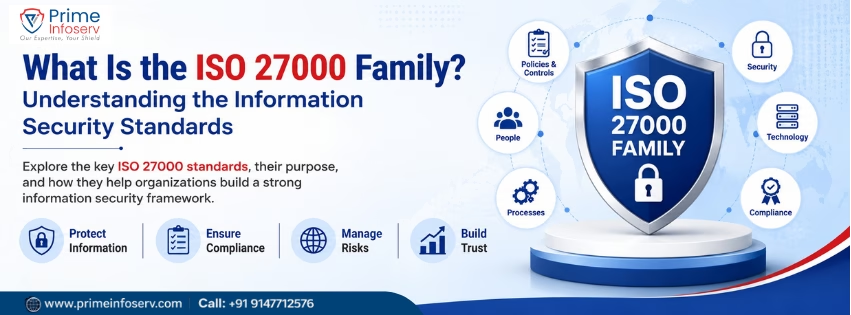
The ISO 27000 family consists of internationally recognized standards that help organizations establish, implement, maintain, and continually improve their information security practices. Together, these standards provide a structured approach to managing cybersecurity risks, protecting sensitive information, ensuring business continuity, and meeting regulatory requirements.
Whether your organization is beginning its information security journey or looking to strengthen an existing Information Security Management System (ISMS), understanding the ISO 27000 family is the first step toward building cyber resilience.
What Is the ISO 27000 Family?
The ISO/IEC 27000 family is a collection of international standards developed by the International Organization for Standardization (ISO) and the International Electrotechnical Commission (IEC).
These standards provide guidance for:
- Managing information security risks
- Protecting confidential, sensitive, and business-critical information
- Implementing security controls
- Responding to cybersecurity incidents
- Managing cloud and privacy risks
- Improving organizational resilience
- Demonstrating security compliance to customers and regulators
Rather than focusing on individual technologies, the ISO 27000 family emphasizes a risk-based management approach, helping organizations protect information regardless of where it resides—on-premises, in the cloud, or across hybrid environments.
Why Does the ISO 27000 Family Matter?
Cyber threats continue to evolve, and organizations face increasing pressure from customers, partners, and regulators to demonstrate strong security practices.
Implementing standards from the ISO 27000 family helps organizations:
- Reduce cybersecurity risks
- Protect customer and business data
- Build customer trust
- Meet contractual security requirements
- Support compliance with regulations such as the Digital Personal Data Protection (DPDP) Act, GDPR, and industry-specific frameworks
- Improve business continuity
- Strengthen governance and risk management
- Create a culture of continual improvement
Instead of reacting to security incidents, organizations become proactive in identifying and managing risks.
Understanding the Key Standards in the ISO 27000 Family
While the ISO 27001 consulting services family includes many standards, a few serve as the foundation for most organizations.
ISO/IEC 27000 – Vocabulary and Overview
This standard introduces the concepts, terminology, and overall structure of the ISO 27000 family.
Think of it as the glossary and roadmap that helps organizations understand how the different standards fit together.
It defines important terms such as:
- Information Security Management System (ISMS)
- Risk assessment
- Information assets
- Security controls
- Confidentiality
- Integrity
- Availability
ISO/IEC 27001 – Information Security Management System (ISMS)
ISO 27001 certification is the best-known and only certifiable standard within the ISO 27000 family.
It specifies the requirements for establishing, implementing, maintaining, and continually improving an ISMS.
Organizations pursuing ISO 27001 certification must demonstrate that they have:
- Identified information security risks
- Implemented appropriate controls
- Defined security policies
- Established governance processes
- Conducted internal audits
- Performed management reviews
- Committed to continual improvement
ISO 27001 certification demonstrates to customers, regulators, and stakeholders that security is managed systematically—not reactively.
ISO/IEC 27002 – Information Security Controls
While ISO 27001 specifies what organizations must achieve, ISO 27001 consultants Kolkata provides guidance on how to implement security controls.
It explains best practices for areas such as:
- Access control
- Asset management
- Cryptography
- Physical security
- Supplier security
- Incident management
- Network security
- Secure development
- Logging and monitoring
Organizations commonly use ISO 27002 alongside ISO 27001 during implementation.
ISO/IEC 27005 – Information Security Risk Management
Risk management is the foundation of an effective ISMS.
ISO 27005 provides guidance on:
- Identifying information security risks
- Assessing business impact
- Evaluating likelihood
- Prioritizing risks
- Selecting treatment options
- Monitoring residual risk
It complements the risk assessment requirements outlined in ISO 27001 consultants India.
ISO/IEC 27017 – Cloud Securi
As organizations increasingly adopt cloud services, cloud-specific security risks become more important.
ISO 27017 extends ISO 27002 by providing guidance for:
- Cloud service providers
- Cloud service customers
- Shared responsibility models
- Virtual environment security
- Cloud administration
- Secure data handling
This standard is particularly valuable for organizations using public or hybrid cloud environments.
ISO/IEC 27018 – Protection of Personal Data in the Cloud
ISO 27018 focuses on protecting personally identifiable information (PII) processed by public cloud service providers.
It helps organizations:
- Manage customer privacy
- Control personal data processing
- Improve transparency
- Strengthen cloud privacy controls
It is especially relevant for organizations handling sensitive customer information.
ISO/IEC 27701 – Privacy Information Management System (PIMS)
Although technically an extension of ISO 27001 company in India and ISO 27002, ISO 27701 expands information security into privacy management.
It supports compliance with privacy regulations by helping organizations:
- Manage personal data responsibly
- Define privacy roles and responsibilities
- Improve accountability
- Demonstrate privacy governance
Organizations pursuing data privacy maturity often implement ISO 27701 alongside ISO 27001.
ISO/IEC 27035 – Information Security Incident Management
Security incidents are inevitable.
What matters is how quickly organizations detect, respond, recover, and learn from them.
ISO 27035 provides guidance for:
- Incident preparation
- Detection
- Reporting
- Assessment
- Response
- Recovery
- Post-incident review
This standard strengthens organizational cyber resilience.
How the ISO 27000 Family Works Together
Rather than replacing one another, these standards complement each other.
A typical implementation might look like this:
| Standard | Primary Purpose |
|---|---|
| ISO 27000 | Terminology and overview |
| ISO 27001 | Requirements for an ISMS |
| ISO 27002 | Guidance on implementing security controls |
| ISO 27005 | Information security risk management |
| ISO 27017 | Cloud security guidance |
| ISO 27018 | Protection of personal information in cloud environments |
| ISO 27701 | Privacy information management |
| ISO 27035 | Incident management |
Together, they create a comprehensive framework for managing information security across people, processes, and technology.
Who Should Implement ISO 27000 Standards?
Organizations of all sizes and industries can benefit from adopting the ISO 27000 family, including:
- IT and software companies
- Managed Service Providers (MSPs)
- Financial institutions
- Healthcare organizations
- Manufacturing companies
- Government agencies
- E-commerce businesses
- Cloud service providers
- Consulting firms
- Educational institutions
- Organizations handling sensitive customer or employee information
Implementation can be tailored to an organization’s size, complexity, and risk profile.
Common Misconceptions About the ISO 27000 Family
“ISO 27001 Is Only for Large Enterprises”
Small and medium-sized businesses also benefit from structured information security management, particularly when serving enterprise clients or regulated industries.
“ISO 27001 Is an IT Project”
Information security extends beyond technology. Effective implementation involves leadership, HR, legal, operations, procurement, and every employee.
“Certification Guarantees No Cyberattacks”
No certification can eliminate cyber threats. ISO 27001 helps organizations establish effective processes to reduce risks and respond more effectively when incidents occur.
“Compliance Ends After Certification”
Information security requires continuous monitoring, audits, management reviews, and ongoing improvement to remain effective.
How Prime Infoserv Helps Organizations Navigate the ISO 27000 Family
Understanding the ISO 27000 family is only the first step. Successfully implementing these standards requires expertise, planning, and continuous improvement.
At Prime Infoserv, we help organizations build resilient information security programs through end-to-end consulting and implementation services, including:
- ISO 27001 readiness assessments
- Gap analysis and roadmap development
- Information Security Management System (ISMS) implementation
- Risk assessments and treatment planning
- Security policy and documentation development
- Internal audits
- Employee awareness and training
- Certification audit support
- Continuous compliance and improvement
Our approach aligns information security with business objectives, enabling organizations to strengthen governance, reduce cyber risk, and build trust with customers and stakeholders.
Final Thoughts
The ISO 27000 family is more than a collection of standards—it is a comprehensive framework for managing information security in an increasingly complex digital landscape.
By understanding how standards such as ISO 27001, ISO 27002, ISO 27005, ISO 27017, ISO 27018, ISO 27701, and ISO 27035 work together, organizations can develop a structured, risk-based approach to protecting information, improving resilience, and demonstrating security maturity.
Whether your goal is achieving certification, meeting regulatory requirements, or strengthening customer confidence, the ISO 27000 family provides a globally recognized foundation for sustainable information security.
Frequently Asked Questions (FAQs)
1. What is the ISO 27000 family?
The ISO 27000 family is a collection of international standards that provide guidance for managing information security, risk, privacy, cloud security, and incident response through an Information Security Management System (ISMS).
2. Is ISO 27001 the same as ISO 27000?
The standards help organizations establish governance, risk management, security controls, and privacy practices that support compliance with regulations such as the DPDP Act, GDPR, HIPAA, and other industry-specific requirements.
3. Which ISO 27000 standard is certifiable?
ISO/IEC 27001 is the primary certifiable standard within the ISO 27000 family.
4. Do organizations need to implement every ISO 27000 standard?
No. Organizations typically implement ISO 27001 as the foundation and adopt additional standards—such as ISO 27002, ISO 27005, or ISO 27701—based on their business needs, industry, and regulatory obligations.
5. How does the ISO 27000 family support regulatory compliance?
The standards help organizations establish governance, risk management, security controls, and privacy practices that support compliance with regulations such as the DPDP Act, GDPR, HIPAA, and other industry-specific requirements.