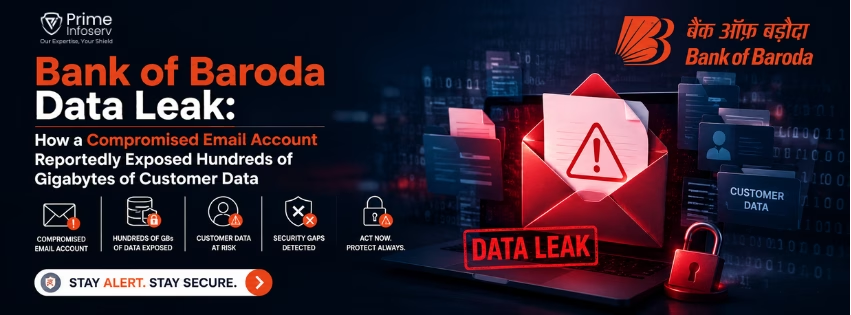
A major cybersecurity incident involving Bank of Baroda has once again demonstrated that an organisation’s most critical data may be exposed without attackers directly breaching its core transaction-processing systems.
Bank of Baroda confirmed on July 27, 2026, that an employee email account had been compromised, resulting in unauthorised access to certain information. The bank said that immediate containment measures had been implemented, a comprehensive forensic investigation had been initiated, and relevant authorities were being engaged.
Importantly, the bank stated that its Core Banking System was not accessed and continued to remain secure.
However, reports from cybersecurity researchers and dark-web monitoring sources suggest that the volume and sensitivity of the exposed information could be substantial.
What reportedly happened?
The incident first gained public attention after a threat actor allegedly published a large Bank of Baroda data repository on a dark-web leak site.
Initial reports described the collection as approximately 1,000 GB, or 1 TB, of data. Independent metadata analysis cited by Reuters suggested that the advertised cache contained more than 700 GB of information.
The data reportedly appeared on the dark web on the night of Saturday, July 25, 2026. As of July 28, the precise volume, authenticity of every document, number of affected individuals and complete period covered by the data had not been officially confirmed.
The available information therefore needs to be divided into two categories:
Confirmed by Bank of Baroda
Bank of Baroda has confirmed that:
- An employee email account was compromised.
- The compromise resulted in unauthorised access to certain data.
- Immediate containment measures were implemented.
- A forensic investigation is underway.
- The bank is working with relevant authorities.
- Its Core Banking System was not accessed and remains secure.
Reported but not yet fully validated
Cybersecurity researchers and media reports have claimed that the exposed repository may contain:
- Customer names and contact details
- Aadhaar and other identification documents
- Savings and current-account-related records
- Loan applications and supporting documents
- Net-banking-related information
- NRI banking records
- Corporate banking documents
- Customer-support records
- Branch and ATM-related documents
- Internal audit and compliance material
Reuters independently reported that samples examined by a cybersecurity researcher contained customer details, identity documents, loan papers and internal audit records. The total number of affected customers remained unknown.
These categories should continue to be described as reported or alleged until the bank’s forensic investigation establishes the exact nature and scope of the exposure.
The Core Banking System was secure—so why is the incident still serious?
The distinction between a core-system compromise and a data breach is important, but it should not lead to an underestimation of the incident.
A bank’s Core Banking System processes account balances, transactions, deposits, loans and other central banking functions. If this system was not accessed, it indicates that the attackers may not have obtained direct control over the bank’s central transaction environment.
However, banking data exists far beyond the Core Banking System.
Sensitive information is routinely present in:
- Employee mailboxes
- Email attachments
- Shared folders
- Document-management systems
- Customer-service platforms
- Loan-processing workflows
- Audit repositories
- Vendor communications
- Local desktops and laptops
- Cloud collaboration platforms
- Archived mailboxes
- Scanned KYC documents
- Branch-level operational records
An email account belonging to an employee with access to sensitive communications can become a gateway to years of accumulated customer information, attachments, internal documents and connected services.
This incident therefore highlights a critical cybersecurity reality:
An organisation can protect its core application successfully and still suffer a major data breach through its identity, email, collaboration or document-management environment.
How can one compromised mailbox expose so much information?
A mailbox is rarely just a messaging tool.
In many organisations, email becomes an unofficial document repository. Employees send and receive KYC documents, account statements, loan papers, audit responses, spreadsheets, customer complaints, access details and operational reports.
Several possible scenarios could explain how a compromised email identity might lead to a much larger exposure:
1. Historical mailbox access
If the attacker obtained persistent access, they may have downloaded years of email messages and attachments.
2. Compromise of connected cloud services
The same account may have been connected to cloud storage, collaboration platforms, shared drives or document repositories.
3. Credential reuse
The compromised credentials might have been reused across other internal or external systems.
4. Session-token theft
Even where multi-factor authentication was enabled, stolen browser cookies or authentication tokens may have allowed an attacker to hijack an authenticated session.
5. Excessive access permissions
The affected user may have had access to shared mailboxes, departmental folders, customer repositories or audit documentation beyond what was necessary for the role.
6. Email forwarding or persistence rules
Attackers commonly create hidden forwarding rules, malicious inbox rules, delegated access or OAuth application permissions to maintain access even after a password is changed.
The precise mechanism in the Bank of Baroda incident remains subject to forensic investigation. Nevertheless, these are among the areas organisations should examine following any suspected business-email compromise.
Why the exposed information could remain dangerous for years
Unlike passwords, many forms of identity information cannot easily be changed.
A password can be reset. An Aadhaar number, date of birth, permanent address, historical loan document or signature sample may remain associated with an individual for years.
When multiple pieces of information are exposed together, criminals can create detailed profiles of customers. These profiles may subsequently be used for:
- Highly personalised phishing attacks
- Fake KYC-verification calls
- Loan and credit fraud
- SIM-swap attempts
- Account-recovery abuse
- Identity impersonation
- Social-engineering attacks
- Fraudulent customer-support interactions
- Business-email compromise
- Targeting of senior citizens or high-value customers
Customers may receive calls or messages containing genuine information such as their branch, loan type, partial account information or identity details. That accuracy can make a fraudulent communication appear legitimate.
The greatest downstream danger may therefore not be an immediate withdrawal from a bank account, but the creation of an extensive and reusable fraud-enablement dataset.
Cyber insurance notification reported
The Economic Times reported that Bank of Baroda had notified a preliminary claim under its cyber-insurance programme while forensic investigations continued.
According to the report, the programme had total coverage of approximately ₹750 crore, with National Insurance acting as the lead insurer. The notification was described as an initial notice of loss, while any eventual payout would depend on factors such as financial loss, regulatory action, business interruption and third-party liability.
Cyber insurance can assist with forensic expenses, legal support, notification costs, system restoration, liability claims and crisis management. However, insurance is a financial risk-transfer mechanism—it cannot restore compromised privacy or prevent stolen data from being reused.
Regulatory implications
As a regulated bank, Bank of Baroda operates within overlapping cybersecurity, banking and data-protection obligations.
RBI’s cybersecurity framework for banks requires prompt reporting of significant cyber incidents. The framework identifies incidents such as data breaches and prescribes reporting to RBI within a period of approximately two to six hours, depending on the nature of the incident.
CERT-In’s incident-reporting directions also require specified cyber incidents to be reported promptly. The Economic Times reported that the Bank of Baroda incident had been notified to CERT-In.
The incident is also relevant to India’s evolving Digital Personal Data Protection framework. Where personal data is compromised, organisations need the ability to determine:
- What personal data was affected
- Which individuals were impacted
- Whether the information was encrypted or masked
- What harm could arise
- Which vendors or processors were involved
- How affected individuals should be informed
- What evidence demonstrates containment
- What corrective action has been taken
The incident reinforces the need for banks and other organisations to treat privacy compliance, cyber incident response and data governance as one integrated programme rather than separate compliance exercises.
What Bank of Baroda customers should do
Customers should remain alert without panicking.
The bank has stated that its Core Banking System remains secure. Nevertheless, customers should assume that fraudsters may attempt to exploit publicity surrounding the incident.
Be suspicious of KYC-related calls
Do not trust callers merely because they know your name, branch, loan details or partial account information.
Never share an OTP, PIN, CVV or password
Bank of Baroda states that customers should never disclose confidential details such as an OTP, CVV, PIN or complete card information. It also warns that bank employees and agents do not call customers asking for such information.
Avoid links sent through SMS, WhatsApp or email
Do not open a link claiming that your account will be blocked unless you immediately update KYC information.
Access banking services by typing the official website address manually or using the official mobile application.
Review account activity
Check bank statements, card transactions, beneficiary additions, loan enquiries and login alerts for anything unusual.
Change reused passwords
Customers who have reused their banking-related email password on other services should change those passwords immediately. Each important account should have a unique password.
Enable transaction alerts
Ensure that SMS and email alerts are enabled and that the registered contact details are current.
Report unauthorised activity immediately
Bank of Baroda lists 1800 5700 and 1800 5000 for reporting loss of cards, fraud or unauthorised transactions. The bank also provides mechanisms for freezing an account or blocking a card through its official channels.
Customers should independently verify these details through the bank’s official website rather than relying on numbers received through forwarded messages.
The larger lesson for banks and enterprises
The most important lesson from this incident is not simply “improve email security.”
The larger issue is the volume of sensitive data that can accumulate behind a single identity.
Organisations should urgently assess the following areas:
Phishing-resistant authentication
Traditional password-plus-OTP security may not be sufficient against adversary-in-the-middle phishing and session hijacking. High-risk users should be moved towards phishing-resistant authentication technologies.
Conditional access
Access decisions should consider device health, location, user risk, impossible travel, new browsers, unusual downloads and abnormal authentication behaviour.
Mailbox threat detection
Security teams should continuously monitor suspicious forwarding rules, unusual mailbox searches, mass attachment downloads, OAuth grants and changes to delegated access.
Data Loss Prevention
DLP policies should identify and control Aadhaar numbers, PAN details, account information, customer records, identity documents and other regulated data across email, endpoints and cloud storage.
Least-privilege access
Employees should have access only to the information required for their current role. Access to shared mailboxes, customer folders and audit repositories should be reviewed regularly.
Retention control
Email should not become a permanent archive for sensitive customer documents. Organisations must define what information can remain in a mailbox, for how long and under what protection.
Data discovery and classification
Banks cannot protect data they cannot locate. Automated discovery should identify personal and financial information across mailboxes, file servers, cloud platforms, databases, endpoints and backup environments.
Behaviour analytics
Mass downloads, abnormal searches, access outside normal working patterns and unusual movement of files should generate real-time alerts.
Dark-web monitoring
Organisations need the ability to identify when corporate credentials, internal documents or customer information appear in criminal marketplaces and leak forums.
Forensic readiness
Logs from identity platforms, email gateways, endpoints, DLP tools, cloud services and network controls should be centrally retained and protected from tampering.
Breach-response exercises
Management, cybersecurity, legal, compliance, privacy, communications, customer support and cyber-insurance teams should practise coordinated breach-response scenarios.
Data exposure registers must become operational
The incident also shows why every organisation needs a working Personal Data Exposure Register.
Such a register should identify:
- What personal data is collected
- Why it is processed
- Where it is stored
- Who can access it
- Which third parties process it
- How it moves between systems
- How long it is retained
- How it is deleted
- Which security controls protect it
- What evidence demonstrates compliance
Without this visibility, an organisation may contain an attacker but still struggle to determine exactly what was exposed.
This uncertainty delays customer notification, regulatory reporting, forensic analysis and corrective action.
Final perspective
The Bank of Baroda incident is still developing, and the final forensic findings may alter the current understanding of its scale and origin.
What is already clear, however, is that cybersecurity cannot be measured solely by whether a firewall, transaction platform or Core Banking System remained online.
The bank’s core systems may have remained secure, while sensitive information accessible through an employee identity was allegedly exposed at significant scale.
That distinction matters.
Modern cyber resilience requires organisations to protect not only applications and networks, but also identities, mailboxes, cloud platforms, documents, data flows and the accumulated information employees handle every day.
A compromised mailbox should remain a contained identity incident.
It should never become a gateway to hundreds of gigabytes of customer information.
Disclaimer: This article is based on information publicly available as of July 28, 2026. References to the volume and categories of information exposed are based on media reports, researcher observations and claims associated with the dark-web publication. The final scope, authenticity of all files and number of affected customers remain subject to Bank of Baroda’s forensic investigation and official regulatory findings.