
The landscape of data privacy in India has undergone a historic transformation with the introduction of the Digital Personal Data Protection Act, 2023 (DPDP Act). Organizations that collect, process, store, or share digital personal data must now adopt a structured compliance framework to meet evolving regulatory expectations.
Data privacy is no longer an IT responsibility alone—it is a boardroom priority. Organizations that fail to implement appropriate privacy and security controls may face significant financial penalties, regulatory scrutiny, operational disruption, and reputational damage.
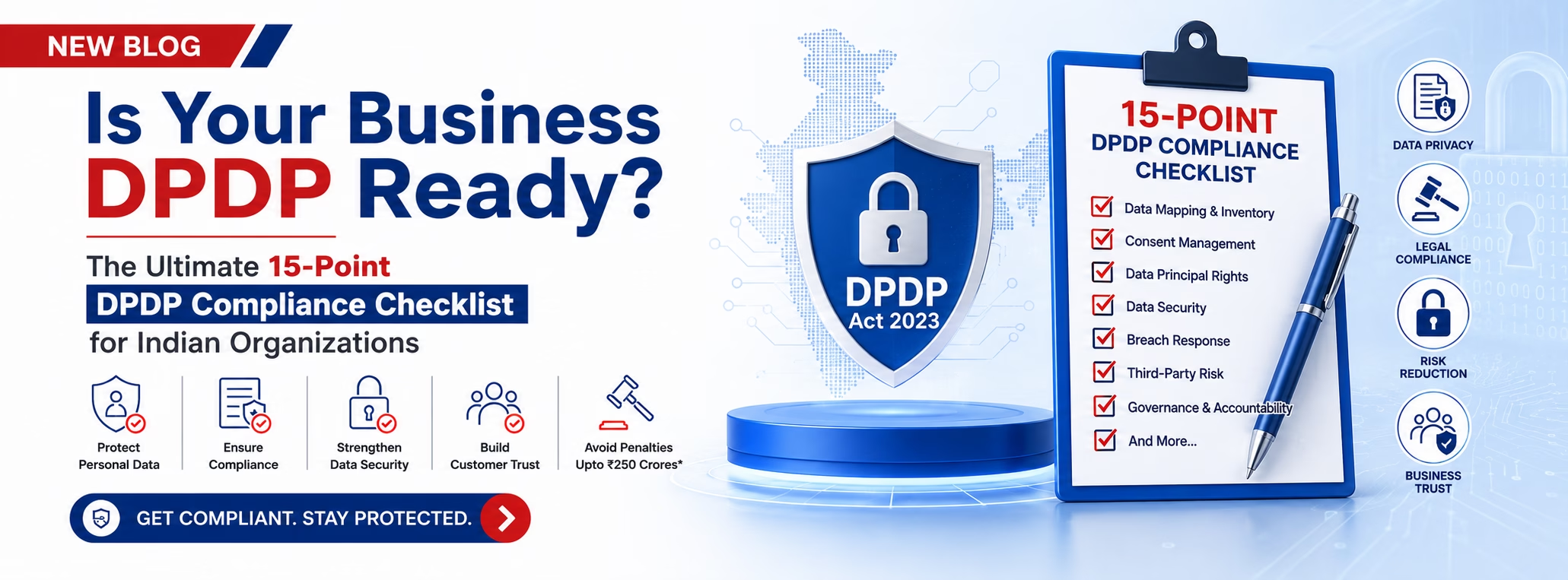
Whether you’re a startup, SME, or large enterprise, proactive compliance is essential. This 15-point DPDP compliance checklist, developed by the cybersecurity and Governance, Risk & Compliance (GRC) experts at Prime Infoserv, will help you assess your organization’s readiness and identify areas that require immediate attention.
Phase 1: Advanced Data Discovery & Consent Frameworks
Compliance begins with comprehensive visibility. If your business cannot pinpoint exactly where its personal
data resides or how it was collected, aligning with the DPDP Act is mathematically impossible.
- Enterprise Data Inventory & Mapping: Conduct thorough data discovery across all cloud
repositories, structural databases, legacy systems, and endpoints. Document the lifecycle of every
element of Personal Data from intake through processing to destruction. - Itemized and Multilingual Notices: Rewrite all front-end privacy notices to be itemized, clear, and
unambiguous. Ensure that privacy notices are explicitly translatable into English as well as the 22
scheduled languages under the Indian Constitution based on user preference. - Simplified Consent Revocation: Establish user interface mechanisms that make the withdrawal of
consent as seamless, simple, and rapid as giving it. Once consent is withdrawn, processing must
cease instantly. - Legacy and Historical Data Validation: Audit all personal records captured prior to the
enforcement of the Act. Send clean, itemized fresh notices to validation pools to maintain legal ground
for processing existing customer repositories.
Phase 2: Enforcing Data Principal Rights
The DPDP Act legally empowers the individual (the Data Principal) with absolute control over their digital
footprint. Organizations acting as Data Fiduciaries must build functional systems to process these requests.
Phase 3: Safeguarding Vulnerable Data & SDF Designations
Processing data related to minors or operating on a macro scale triggers enhanced regulatory obligations that
necessitate heavy structural controls.
Phase 4: Security Architecture & Incident Management
Legal policies are only as strong as the technical controls backing them. The security of data systems dictates
your ultimate exposure to regulatory penalties.
- Right to Access Real-Time Summaries: Implement technical workflows allowing individuals to
request and immediately receive a summary of their processed personal data, third parties shared
with, and the underlying logic of processing. - Correction, Completeness, and Deletion Pipelines: Provide easily accessible self-service portals
or automated workflows for users to update, correct, complete, or request the absolute erasure of their
information. - Dedicated Grievance Redressal Mechanisms: Appoint a formalized Grievance Officer and
publish their contact information openly. Establish clear service level agreements (SLAs) for solving
client privacy issues effectively. - Verifiable Parental Consent Architecture: Build robust, age-gated verification systems. The DPDP
Act explicitly prohibits tracking, behavioral monitoring, or targeted commercial advertising directed at
individuals below 18 years of age. - Significant Data Fiduciary (SDF) Structuring: Analyze your organization’s position against
government criteria. If categorized as an SDF due to scale or strategic sensitivity, you must appoint a
dedicated, India-based Data Protection Officer (DPO) and mandate recurring Data Protection Impact
Assessments (DPIAs). - Deployment of Advanced Security Controls: Enforce zero-trust architecture, robust data
encryption (both at rest and in transit), continuous multi-factor authentication, and strict access control
mechanisms. - Mandatory Breach Notification Procedures: Formulate an emergency incident response plan
that guarantees immediate notification to the Data Protection Board of India (DPBI) and all affected
users in the event of a breach. - Vulnerability Assessment and Penetration Testing (VAPT): Schedule regular, exhaustive
automated and manual technical security audits to actively find, patch, and eradicate infrastructural
loop-holes.
Phase 5: Supply Chain Management & Governance
Organizational risk spreads across all external dependencies. Managing third-party risk profiles ensures
holistic regulatory posture safety.
- Third-Party Data Processor Agreements: Revise all active master service agreements with
vendors, sub-contractors, and cloud providers. Data processors must legally bound themselves to
operate only under explicit fiduciary guidelines. - Purging and Automatic Retention Rules: Introduce rigid database retention scripts that auto-
delete personal data blocks immediately after the designated legal or business execution purpose concludes.
- Cross-Organizational Privacy Training: Run sustained educational campaigns across all
business units to ensure engineering, marketing, HR, and operation teams understand safe data
practices.
Secure Your Enterprise with Prime Infoserv
Achieving absolute alignment with the DPDP Act involves diving deep into enterprise workflows, system
behaviors, and policy structures. Relying on basic web templates or generic IT configurations exposes
your brand to devastating regulatory fines and brand loss.
As a leading cybersecurity advisory and Governance, Risk, and Compliance
(GRC) expert company, Prime Infoserv manages your end-to-end alignment transition smoothly. We
deliver deep gap assessments, structured technical audits, enterprise data mapping, data lifecycle
design, and tailored employee privacy training matrices.
Ensure your operational security today.




Pingback: 262 Days to DPDP Compliance: Why Indian Organisations Must Start Preparing Now - Prime Infoserv Pvt. Ltd.