The Cybersecurity Landscape Has Changed Overnight
What if an AI system could discover thousands of software vulnerabilities in just a few weeks—some of which had remained hidden for decades?
This is no longer a hypothetical scenario.
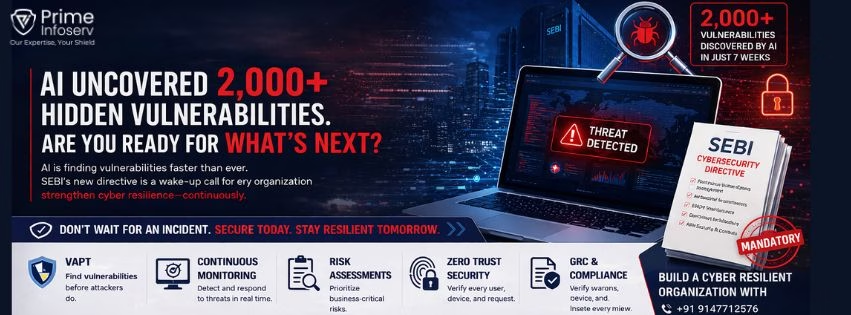
Recent reports revealed that Anthropic’s AI model, Claude Mythos Preview, identified more than 2,000 previously unknown software vulnerabilities within seven weeks and reportedly generated working exploits in a significant number of cases. The development has sent shockwaves through the cybersecurity industry and prompted the Securities and Exchange Board of India (SEBI) to strengthen cybersecurity expectations across India’s financial ecosystem.
The message is clear:
For businesses, this is not just a technology concern—it’s a business, compliance, and reputation risk.
Why SEBI’s Cybersecurity Directive Matters
In response to the growing threat posed by AI-driven vulnerability discovery, SEBI issued a comprehensive cybersecurity directive to regulated entities, including stock exchanges, mutual funds, depositories, credit rating agencies, portfolio managers, and other market participants.
SEBI highlighted a major concern: the interconnected nature of today’s digital ecosystem means that a single security breach can potentially trigger widespread operational disruptions.
To strengthen cyber resilience, SEBI has emphasized:
- Continuous Vulnerability Management
- Immediate Security Patching
- AI-Assisted Vulnerability Assessments
- Software Bill of Materials (SBOM) Maintenance
- API Security Controls
- Zero Trust Network Architecture (ZTNA)
- Continuous Security Monitoring
- Preparedness Against AI-Driven Threats
While these requirements directly apply to financial institutions, the lessons extend to every organization that handles sensitive customer, employee, or business data.
The era of annual security reviews is ending. Continuous cybersecurity is becoming the new standard.
Why Every Business Should Pay Attention
Many organizations still rely on traditional cybersecurity approaches such as:
- Annual security audits
- Periodic vulnerability assessments
- Reactive patch management
- Compliance-focused security programs
However, cyber threats no longer operate on fixed schedules.
A vulnerability discovered today can be weaponized tomorrow.
As businesses increasingly adopt cloud computing, AI tools, remote work environments, APIs, and open-source software, the attack surface continues to expand.
This means organizations need to move beyond periodic security exercises and embrace ongoing cyber risk management.
The Rise of AI-Powered Cybersecurity Threats
Artificial Intelligence is transforming cybersecurity on both sides of the battlefield.
How AI Benefits Security Teams
Organizations can leverage AI to:
- Detect vulnerabilities faster
- Automate threat analysis
- Improve incident response
- Enhance security monitoring
- Prioritize cyber risks
How Attackers Can Use AI
Cybercriminals can use AI to:
- Identify vulnerabilities at scale
- Automate reconnaissance activities
- Develop sophisticated phishing campaigns
- Accelerate exploit development
- Increase the speed and sophistication of attacks
This growing imbalance means businesses must continuously evaluate and improve their cybersecurity posture.
Vulnerability Management Is No Longer Optional
One of the biggest lessons from SEBI’s directive is the importance of continuous vulnerability management.
Many organizations mistakenly assume that occasional testing is enough.
In reality, vulnerabilities are discovered every day.
Effective vulnerability management involves:
Identifying Security Weaknesses
Organizations must continuously scan and assess their environments for security flaws.
Prioritizing Business-Critical Risks
Not every vulnerability poses the same level of risk. Businesses need a structured approach to prioritize remediation efforts.
Applying Patches Quickly
Delays in patch management often create opportunities for attackers.
Monitoring Emerging Threats
Continuous monitoring helps organizations stay ahead of newly discovered vulnerabilities.
Innovation’s Greatest Strength and Hidden Risk
Modern applications depend heavily on open-source software.
While open-source technologies accelerate innovation and reduce costs, they can also introduce hidden security challenges.
Many businesses lack visibility into:
- Open-source components in use
- Known vulnerabilities within those components
- Dependency-related risks
- Security update status
This is why SEBI has emphasized maintaining a Software Bill of Materials (SBOM) for critical applications.
An SBOM helps organizations understand what software components exist within their systems and identify vulnerabilities more effectively.
Without this visibility, businesses may unknowingly expose themselves to significant cyber risks.
Why Cybersecurity Has Become a Boardroom Priority
Cybersecurity is no longer solely an IT responsibility.
A successful cyberattack can impact:
Customer Trust
Data breaches can damage an organization’s reputation and erode customer confidence.
Regulatory Compliance
Businesses must increasingly demonstrate their ability to protect sensitive information.
Financial Performance
Cyber incidents often result in operational disruption, legal costs, and remediation expenses.
Business Continuity
A single security incident can interrupt critical operations and impact long-term growth.
As a result, cybersecurity is now a strategic business issue that requires executive attention.
How Businesses Can Strengthen Their Cybersecurity Posture
Organizations looking to stay ahead of evolving threats should focus on:
Vulnerability Assessment & Penetration Testing (VAPT)
Regular VAPT exercises help identify weaknesses before attackers exploit them.
Continuous Security Monitoring
Real-time monitoring enables faster detection and response to suspicious activities.
Risk Assessments
Understanding business-critical risks helps organizations allocate resources more effectively.
Security Awareness Training
Employees remain one of the most important lines of defense against cyber threats.
Zero Trust Security
Trust should never be assumed. Every user, device, and access request must be verified continuously.
Governance, Risk & Compliance (GRC)
Strong governance frameworks help align cybersecurity initiatives with business objectives and regulatory requirements.
How Prime Infoserv Helps Organizations Stay Ahead of Emerging Cyber Threats
As AI-powered threats continue to evolve, organizations need a proactive cybersecurity strategy.
Prime Infoserv helps businesses strengthen cyber resilience through:
- Vulnerability Assessment & Penetration Testing (VAPT)
- Governance, Risk & Compliance (GRC) Consulting
- Information Security Audits
- Risk Assessments
- Cybersecurity Consulting
- Security Awareness Training
- Compliance Readiness Assessments
- Information Security Advisory Services
Our experts help organizations identify vulnerabilities, reduce cyber risks, and implement security measures that support long-term business growth.
The Future of Cybersecurity Will Be Defined by Speed
The recent discovery of more than 2,000 vulnerabilities by an AI system is a reminder that cybersecurity threats are evolving faster than ever before.
Organizations can no longer rely solely on periodic audits or compliance-driven approaches.
Instead, they must embrace:
- Continuous Vulnerability Management
- Proactive Risk Assessments
- Real-Time Monitoring
- Strong Governance Practices
- AI-Enhanced Security Programs
The question is no longer whether vulnerabilities exist within your environment.
The real question is:
Can you identify and fix them before attackers do?
Related Reading
Explore our latest cybersecurity and compliance insights:
- Why DPDP Compliance Requires More Than Legal Documentation
- Beyond the ₹250 Crore Penalty: Why Hospitals Must Rethink Data Privacy Before the Next Breach
Secure Your Business Before the Next Vulnerability Becomes a Breach
Cyber threats are evolving rapidly, and organizations need proactive security strategies to stay protected.
Prime Infoserv helps businesses identify vulnerabilities, strengthen defenses, and improve cyber resilience through expert-led VAPT, GRC, Security Audits, Risk Assessments, and Compliance Consulting services.
📞 Call Us: +91 9147712576
📧 Email: info@primeinfoserv.com
🌐 Visit: https://primeinfoserv.com/
Don’t wait for a cyber incident to reveal your security gaps. Build a stronger cybersecurity foundation with Prime Infoserv today.