
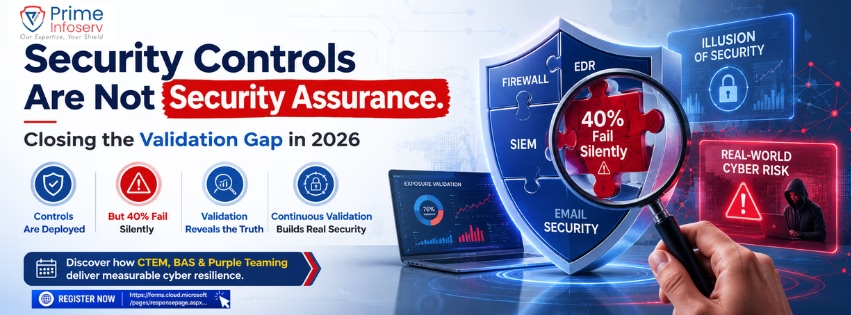
Introduction: The Illusion of Security Coverage
Modern organizations have never invested more in cybersecurity. Security Information and Event Management (SIEM) platforms monitor logs around the clock, Endpoint Detection and Response (EDR) solutions protect endpoints, firewalls filter network traffic, and cloud security platforms continuously scan for misconfigurations.
On paper, everything appears secure.
Dashboards are green. Alerts are under control. Compliance audits are passed.
Yet attackers continue to breach organizations that possess mature security stacks.
Why?
Because deploying security controls is not the same as validating that they actually work.
This distinction is becoming one of the biggest priorities for CISOs and security leaders worldwide. Security teams are shifting from asking “Do we have controls?” to “Can we prove our controls will stop a real-world attack?”
This is the foundation of Continuous Threat Exposure Management (CTEM)—a proactive approach that emphasizes continuous validation, threat-informed defense, and evidence-based security decisions.
What Silent Control Failure Looks Like
Security controls rarely fail with a loud alarm.
Most failures happen quietly, creating hidden gaps that attackers exploit for weeks or months before anyone notices.
Scenario 1: Firewall Misconfiguration
A financial services company deploys a new firewall policy during a routine maintenance window.
The implementation appears successful.
No alerts are generated.
However, one rule unintentionally exposes an internal administrative service to the internet.
For six months, the exposure remains unnoticed because no monitoring process validates whether the firewall configuration aligns with intended security policies.
Everything appears secure—until an attacker discovers the exposed service.
Scenario 2: SIEM Detection Drift
A Security Operations Center depends on hundreds of detection rules.
Over time:
- Applications change
- Infrastructure evolves
- Cloud services expand
- Log formats are modified
Gradually, several critical detection rules stop triggering.
No one notices because the SIEM itself continues operating normally.
The dashboard remains healthy.
The logs continue flowing.
But the organization has unknowingly lost visibility into several attack techniques.
This is known as detection drift, and it is one of the most common silent failures in enterprise security.
The 40% Problem — Why Controls Fail Without Anyone Knowing
Many organizations assume that once a security control is deployed, it continues functioning indefinitely.
Reality is very different.
Security controls degrade over time due to:
- Infrastructure changes
- Software updates
- Cloud migrations
- Policy modifications
- Identity changes
- Configuration errors
- Technology sprawl
Each change introduces uncertainty.
Without continuous validation, organizations have no evidence that:
- EDR agents are properly detecting threats
- Firewall policies block malicious traffic
- SIEM rules generate expected alerts
- Email security identifies phishing campaigns
- Identity controls prevent privilege escalation
These silent failures create a dangerous illusion of protection.
Organizations believe they are secure because controls exist—not because controls have been proven effective.
This creates the Validation Gap, where perceived security differs significantly from actual security posture.
From Controls to Assurance — The Validation Layer
Security assurance requires evidence.
Instead of asking:
“Do we have an EDR solution?”
Security leaders should ask:
“Can our EDR detect ransomware execution today?”
Instead of asking:
“Do we have firewall policies?”
They should ask:
“Can we validate those policies against modern attack techniques?”
Continuous validation transforms cybersecurity from a compliance exercise into measurable risk management.
A modern validation program continuously:
Identify
Discover exposed assets and attack surfaces.
Prioritize
Rank exposures according to business impact and threat intelligence.
Validate
Safely simulate attacker behavior to verify security control effectiveness.
Remediate
Address confirmed weaknesses before adversaries exploit them.
Measure
Provide executives with evidence-based metrics demonstrating actual security performance.
This approach aligns perfectly with CTEM principles and enables organizations to continuously reduce cyber exposure rather than simply manage vulnerabilities.
How Continuous Breach & Attack Simulation + Purple Teaming Close the Gap
Organizations are increasingly adopting Breach & Attack Simulation (BAS) and Purple Teaming to validate security controls continuously.
Breach & Attack Simulation (BAS)
BAS platforms safely emulate real attacker techniques across the enterprise environment.
Rather than waiting for a real attack, organizations proactively test:
- Credential theft
- Lateral movement
- Privilege escalation
- Data exfiltration
- Malware execution
- Command-and-control communication
The objective is simple:
Verify whether existing security controls detect and prevent these attacks.
This transforms assumptions into measurable evidence.
Purple Teaming
Purple Teaming combines offensive and defensive expertise.
Rather than conducting isolated penetration tests, offensive teams collaborate directly with defenders to improve detection capabilities.
Benefits include:
- Improved SOC detection rules
- Faster incident response
- Better threat hunting
- Continuous learning
- Reduced detection gaps
Purple Team exercises provide actionable insights that strengthen both technology and people.
The CTEM Advantage
When BAS and Purple Teaming become continuous processes rather than annual exercises, organizations gain:
✅ Continuous security validation
✅ Reduced attack surface
✅ Faster remediation cycles
✅ Threat-informed prioritization
✅ Higher confidence in security investments
This creates measurable cyber resilience rather than assumed protection.
Building the Evidence-Based Security Program
Today’s boards and executive teams are asking different questions.
Instead of:
“How many vulnerabilities do we have?”
They ask:
“How exposed are we to a real-world cyber attack?”
Security leaders need answers backed by evidence.
An evidence-based security program focuses on metrics such as:
Exposure Validation Rate
How many identified exposures have been verified and tested?
Security Control Effectiveness
Which controls successfully detect and prevent simulated attacks?
Mean Time to Validate (MTTV)
How quickly can the organization verify whether a new control works as expected?
Risk Reduction Trend
Is the organization’s cyber exposure decreasing over time?
Business Impact Prioritization
Are remediation efforts focused on systems that matter most to business operations?
These metrics provide executives and boards with meaningful insights instead of raw vulnerability counts.
Security becomes a measurable business function rather than a technical expense.
Conclusion: Validation Is the New Security Standard
Cybersecurity is entering a new era.
Organizations can no longer rely solely on deployed controls, compliance reports, or vulnerability counts to measure security maturity.
The question has changed from:
“Do we have security controls?”
to
“Can we continuously prove they work?”
Continuous Threat Exposure Management (CTEM), combined with Breach & Attack Simulation and Purple Teaming, enables organizations to close the validation gap, reduce cyber risk, and build measurable business resilience.
Security assurance is no longer about trust.
It’s about continuous validation backed by evidence.
Join the Conversation
Want to learn how leading organizations are transforming cybersecurity into measurable business resilience?
Join the InfoSec Foundation Executive Webinar on Continuous Threat Exposure Management (CTEM) and discover practical strategies for exposure prioritization, security validation, and continuous risk reduction.
👉 Register Now:
https://primeinfoserv.com/ctem-webinar/