
The Security Paradox of 2026
Cybersecurity spending continues to rise year after year. Organizations are investing heavily in SIEM platforms, EDR solutions, cloud security tools, threat intelligence feeds, and vulnerability scanners. Yet despite these investments, successful cyberattacks continue to increase.
This is the security paradox of 2026.
Many organizations can tell you how many vulnerabilities they have discovered, how many alerts their SOC processed, and how much they spent on cybersecurity technologies. What they often cannot tell you is a far more important metric:
How exposed are we to a real-world cyberattack right now?
For years, security teams have relied on vulnerability management (VM) as a primary method for reducing risk. The assumption was simple: find vulnerabilities, patch them, and reduce risk.
Unfortunately, today’s attack landscape is far more complex.
Modern attackers do not exploit every vulnerability. They exploit the vulnerabilities that are reachable, exploitable, and capable of creating business impact. This distinction is forcing organizations to rethink how they approach cyber risk.
The future of cybersecurity is no longer about counting vulnerabilities. It is about measuring exposure.
That future is being driven by Continuous Threat Exposure Management (CTEM).
Why Vulnerability Management Is Failing
Traditional vulnerability management programs were built for a different era.
Organizations scan systems, identify weaknesses, prioritize based on severity scores, and schedule remediation activities. While this approach remains valuable, it is increasingly insufficient in today’s dynamic threat environment.
The reality is startling:
- Research suggests that nearly 95% of identified CVEs are not realistically exploitable within a specific environment
- Enterprise attack surfaces continue to expand, with organizations experiencing an average 23% increase in attack surface complexity
- Security teams face overwhelming volumes of findings while operating with limited resources
- Critical vulnerabilities often remain buried among thousands of low-risk alerts
The result?
Security teams spend enormous effort chasing vulnerability counts while attackers focus on actual attack paths.
A vulnerability may exist.
But if it cannot be reached, exploited, or leveraged to achieve an attack objective, is it truly your highest priority?
Conversely, a seemingly moderate vulnerability that provides direct access to critical assets could represent a significant business risk.
Traditional VM struggles to answer these questions.
This is where exposure management becomes essential.
The Three Gaps Vulnerability Management Cannot Close
Many organizations assume vulnerability management automatically translates into risk reduction.
In reality, three critical gaps prevent that outcome.
1. The Context Gap
Vulnerability scanners provide technical findings but often lack business context.
For example:
- Which assets support critical business functions?
- Which systems contain sensitive customer data?
- Which vulnerabilities create pathways to crown-jewel assets?
Without context, security teams prioritize based on CVSS scores rather than business impact.
A vulnerability rated 9.8 may have less real-world significance than a lower-scored vulnerability sitting on a critical business application.
CTEM helps organizations understand risk in context.
2. The Detection Gap
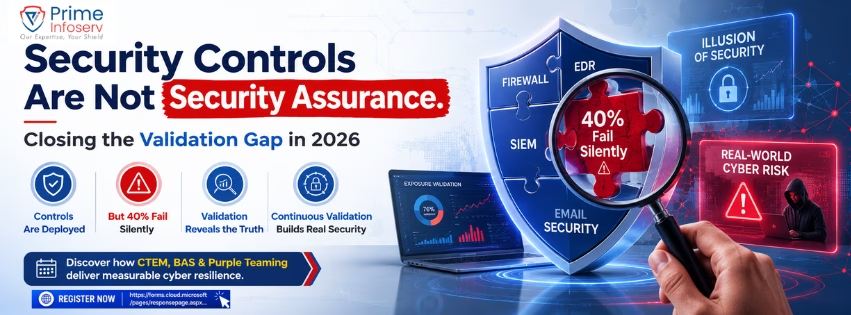
Many organizations assume that because they own security tools, they are protected.
Unfortunately, security controls can fail.
Questions every organization should ask:
- Can our EDR detect this attack technique?
- Will our SIEM generate meaningful alerts?
- Are our security controls configured correctly?
- Can attackers bypass our defenses?
Traditional VM identifies weaknesses but does not validate whether security controls can actually detect and stop attacks.
This creates a dangerous detection gap.
3. The Execution Gap
Even when vulnerabilities are identified and prioritized, remediation often stalls.
Common challenges include:
- Limited resources
- Patch management delays
- Business disruption concerns
- Competing priorities
As a result, vulnerabilities remain unresolved for months.
The execution gap is where many cyber risks persist despite security teams knowing they exist.
Organizations need a framework that continuously validates, prioritizes, and drives action.
That framework is CTEM.
What Is CTEM? The 5-Stage Framework Explained
Continuous Threat Exposure Management (CTEM) is a strategic cybersecurity approach designed to continuously identify, prioritize, validate, and reduce exposure.
Rather than focusing solely on vulnerabilities, CTEM focuses on real-world attackability. Register today to secure your spot for this exclusive executive webinar.
🔗 Visit and Register: https://primeinfoserv.com/ctem-webinar/
The framework consists of five stages:
1. Scoping
Organizations define the environments, assets, business processes, and attack surfaces that matter most.
This ensures security efforts align with business priorities.
2. Discovery
Security teams identify vulnerabilities, exposures, misconfigurations, attack paths, and external-facing risks.
This stage provides visibility across the attack surface.
3. Prioritization
Not every exposure deserves immediate attention.
CTEM evaluates:
- Business impact
- Exploitability
- Asset criticality
- Threat intelligence
- Attack path relevance
This enables organizations to focus on risks that truly matter.
4. Validation
Validation is what differentiates CTEM from traditional vulnerability management.
Organizations test whether:
- Exposures can actually be exploited
- Security controls work as intended
- Detection mechanisms are effective
- Defensive investments deliver measurable outcomes
Validation transforms assumptions into evidence.
5. Mobilization
Finally, organizations take action.
Remediation efforts become focused, measurable, and aligned with business priorities.
Instead of patching everything, teams address what creates the greatest reduction in exposure.
Exposure vs. Vulnerability — Why the Difference Is Everything
Many security programs treat vulnerabilities and exposures as interchangeable.
They are not.
A vulnerability is a weakness.
An exposure is a weakness that creates a realistic opportunity for attack.
Consider the difference:
Vulnerability
- Software flaw exists
- Technical issue identified
- May never be reachable
- May have minimal business impact
Exposure
- Reachable by attackers
- Exploitable in the environment
- Connected to critical assets
- Creates measurable business risk
This distinction changes everything.
Organizations often discover thousands of vulnerabilities.
However, only a small percentage represent genuine exposure.
By focusing on exposure rather than raw vulnerability counts, organizations can:
- Reduce remediation fatigue
- Improve security efficiency
- Prioritize resources effectively
- Demonstrate measurable risk reduction
- Align cybersecurity with business outcomes
Exposure management shifts security from activity-based metrics to outcome-based metrics.
Instead of asking:
“How many vulnerabilities did we patch?”
Organizations begin asking:
“How much exposure did we reduce?”
That is a far more meaningful business conversation.
How to Begin the CTEM Journey Without Replacing Your Stack
One of the biggest misconceptions about CTEM is that it requires organizations to replace their existing security technologies.
It does not.
In fact, CTEM works best by maximizing the value of investments organizations have already made.
Your existing ecosystem may already include:
- Vulnerability Management Platforms
- SIEM Solutions
- EDR/XDR Tools
- Threat Intelligence Platforms
- Cloud Security Tools
- Security Validation Solutions
CTEM acts as the strategic layer that connects these investments.
A practical starting point includes:
Identify Critical Assets
Focus on systems that drive business operations and contain sensitive information.
Map Attack Paths
Understand how attackers could move through your environment.
Prioritize Based on Risk
Combine business impact with exploitability.
Validate Security Controls
Regularly test whether defenses work as expected.
Measure Exposure Reduction
Track outcomes instead of activity metrics.
At Prime Infoserv, we help organizations strengthen cyber resilience through security assessments, vulnerability management, VAPT services, risk assessments, compliance consulting, and exposure-focused cybersecurity strategies. The goal is not simply to discover vulnerabilities—but to understand and reduce the exposures that matter most.
Conclusion: The Future of Cybersecurity Is Exposure Management
The cybersecurity landscape is changing rapidly.
Organizations can no longer afford to measure security success through vulnerability counts alone.
Attackers are not interested in every weakness.
They focus on the exposures that create the highest probability of success.
To stay ahead, organizations must move beyond traditional vulnerability management and adopt a continuous approach that prioritizes, validates, and reduces real-world risk.
CTEM provides that framework.
The organizations that embrace exposure management today will be better positioned to improve resilience, optimize security investments, and make smarter risk decisions tomorrow.

Join the Conversation
Want to learn how leading organizations are implementing CTEM to strengthen cyber resilience?
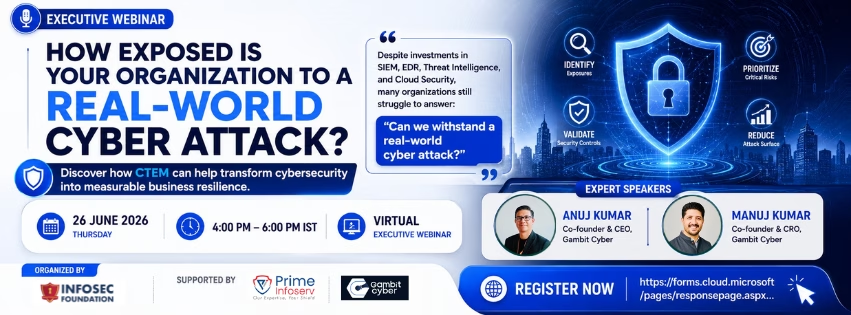
Join the exclusive executive webinar:
Why Prioritization & Validation Matter in 2026
📅 26 June 2026
⏰ 4:00 PM – 6:00 PM IST
💻 Virtual Session