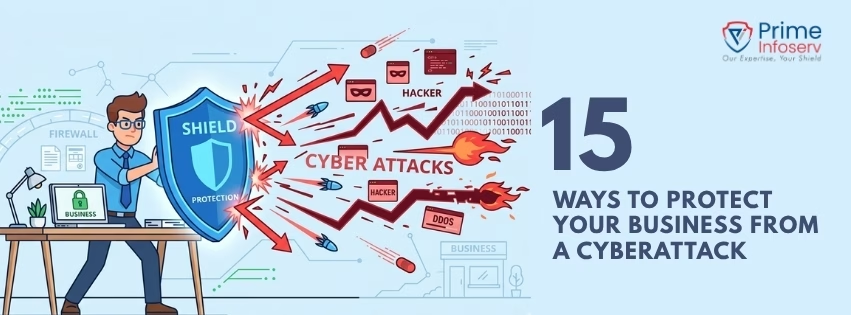
How to Manage Security Risks & Threats is one of the most important challenges for today’s IT industry. With organizations becoming more dependent on digital technologies, the risk of cyberattacks, data breaches, and system vulnerabilities has increased significantly, making proactive security management essential.
Today, cyberattacks are no longer limited to large enterprises. Small and medium-sized organizations are equally targeted due to weak security frameworks, lack of monitoring, and increasing digital dependency.
Understanding the Cyber Risk Landscape
IT organizations today face a wide range of threats, including phishing attacks, ransomware, cloud vulnerabilities, API exploitation, insider threats, and mobile-based malware. With the expansion of technologies like AI, IoT, and remote working environments, the attack surface has grown significantly.
Cybercriminals often exploit small vulnerabilities to gain unauthorized access, steal sensitive data, disrupt operations, or demand ransom. This makes proactive cybersecurity no longer optional—but essential.
Key Approaches to Managing Security Risks
To effectively manage cybersecurity risks, organizations need a structured and proactive security strategy:
1. Vulnerability Assessment & Penetration Testing (VAPT)
Regular security testing helps identify weaknesses before attackers can exploit them. It simulates real-world attack scenarios to strengthen system defenses.
2. Endpoint & Device Security
With remote work becoming common, securing all endpoints—including laptops, mobile devices, and IoT systems—is critical to prevent unauthorized access.
3. Email & Web Security
Most attacks begin through phishing emails or malicious websites. Advanced filtering and monitoring systems help detect and block suspicious activity.
4. Multi-Factor Authentication (MFA)
Passwords alone are no longer sufficient. MFA adds an extra layer of verification, reducing the risk of account compromise.
5. Continuous Monitoring & SIEM
Real-time monitoring of networks and systems ensures early detection of anomalies and potential threats.
The Role of Managed Security Services (MSS)
One of the most effective ways to strengthen cybersecurity posture is through Managed Security Services (MSS).
MSS provides organizations with continuous, expert-driven security support without the need for building a large in-house security team. It includes:
- 24/7 security monitoring and threat detection
- Incident response and rapid mitigation
- Advanced threat intelligence integration
- SIEM-based log analysis and reporting
- Proactive vulnerability management
- Compliance and risk management support
By leveraging MSS, organizations gain access to enterprise-grade security expertise, advanced tools, and continuous protection against evolving cyber threats—at a cost-effective scale.
Check out our services in detail.
Conclusion
Managing cybersecurity risks is no longer a one-time activity but an ongoing process. As threats continue to evolve, organizations must adopt a proactive security model combining VAPT, monitoring, authentication controls, and Managed Security Services.
A well-structured cybersecurity approach not only protects data and infrastructure but also ensures business continuity and long-term digital trust. Call us for a free consultation : +91 9147712576 or mail: infp@primeinfoserv.com