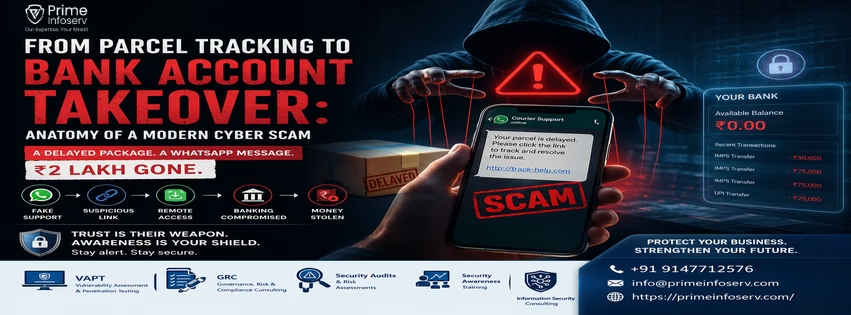
A Delayed Package. A WhatsApp Message. ₹2 Lakh Gone.
You order a package, it gets delayed, and naturally, you contact customer support.
A few messages later, someone claiming to be a courier executive asks you to follow a few simple steps to “resolve the issue.”
What seems like routine customer service can quickly turn into a devastating cyber fraud.
This recently happened to a retired government employee in Nagpur, who lost nearly ₹2 lakh after fraudsters posing as courier company representatives allegedly gained access to his mobile device and banking applications. The incident highlights a growing trend in social engineering attacks, where cybercriminals exploit trust rather than technology. The attack reportedly involved fake customer support interactions via WhatsApp and unauthorized access to banking services.
The alarming reality is that modern cybercriminals no longer need advanced hacking skills to steal money—they simply need your trust.
Why Courier and Delivery Scams Are Increasing
With millions of online deliveries taking place every day, parcel tracking has become a normal part of life.
Cybercriminals know this.
They exploit situations where people are already waiting for deliveries, refunds, account updates, or customer support assistance.
Common scam tactics include:
- Fake courier tracking messages
- WhatsApp customer support scams
- Delivery delay notifications
- Refund processing requests
- KYC verification messages
- Remote access assistance offers
These scams work because they create urgency and appear legitimate.
Victims often believe they are speaking with genuine customer care representatives.
The Real Weapon: Social Engineering
Many people assume cybercrime begins with malware or complex hacking tools.
In reality, most successful cyber attacks begin with social engineering.
Social engineering is the psychological manipulation of individuals into revealing information or granting access.
Fraudsters carefully exploit emotions such as:
- Trust
- Urgency
- Fear
- Confusion
- Frustration
A delayed parcel creates the perfect environment for manipulation because the victim is already looking for help.
Rather than attacking systems, criminals attack human behavior.
How a Simple Inquiry Becomes a Bank Account Takeover
Modern fraud campaigns often follow a predictable pattern:
Step 1: Establish Trust
The attacker contacts the victim posing as:
- Customer care executives
- Delivery agents
- Bank representatives
- Technical support staff
Step 2: Create Urgency
The victim is told that immediate action is required to:
- Track a parcel
- Process a refund
- Verify an account
- Resolve a complaint
Step 3: Gain Device Access
The attacker persuades the victim to:
- Share sensitive information
- Install applications
- Click malicious links
- Grant screen-sharing permissions
- Enable remote device access
Step 4: Financial Exploitation
Once access is obtained, fraudsters can:
- View OTPs
- Access banking apps
- Initiate transactions
- Change account credentials
- Drain funds
This is how an ordinary customer support request can escalate into a full bank account takeover.
Why Mobile Phones Have Become Prime Targets
Today’s smartphones contain:
- Banking applications
- Digital wallets
- Personal information
- Authentication apps
- Email accounts
- Password recovery options
In many cases, a compromised phone provides cybercriminals with everything they need.
This is why mobile security, online banking security, and cybersecurity awareness are becoming increasingly important.
Warning Signs of a Customer Care Scam
Be cautious if someone:
🚩 Contacts you through unofficial WhatsApp numbers
🚩 Requests OTPs or banking details
🚩 Asks you to install remote-access applications
🚩 Shares suspicious tracking links
🚩 Pressures you to act immediately
🚩 Requests screen-sharing permissions
Legitimate organizations rarely ask customers to provide sensitive information through unofficial communication channels.
How Businesses and Individuals Can Protect Themselves
To reduce the risk of becoming a victim:
Verify Before You Trust
Always use official websites and verified customer support numbers.
Never Share OTPs
No legitimate support representative will ask for OTPs.
Avoid Unknown Apps
Never install applications recommended by unknown callers.
Check Before You Click
Avoid clicking suspicious or shortened URLs.
Enable Strong Security Controls
Use:
- Multi-Factor Authentication (MFA)
- Secure passwords
- Biometric protection
- Regular device updates
Invest in Cybersecurity Awareness
Awareness remains one of the strongest defenses against modern cybercrime.
What This Scam Teaches Businesses
Although this incident targeted an individual, the same techniques are used against organizations.
Employees regularly receive:
- Fake invoices
- Vendor impersonation emails
- Support requests
- Delivery notifications
- Business Email Compromise (BEC) attempts
Without proper training, a single employee can unknowingly create a serious security incident.
This is why organizations increasingly invest in:
- Security Awareness Training
- Vulnerability Assessment & Penetration Testing (VAPT)
- Risk Assessments
- Cybersecurity Consulting
- Governance, Risk & Compliance (GRC)
Cybercrime Is Evolving Faster Than Ever
Recent cybersecurity developments show how rapidly the threat landscape is changing.
In our recent blog, “AI Found 2,000 Vulnerabilities in Weeks: Why SEBI Wants Organizations to Rethink Cybersecurity,” we explored how AI-powered systems can discover vulnerabilities at machine speed, forcing businesses to adopt continuous security monitoring and proactive risk management.
Whether it’s AI-driven threats or social engineering scams, the lesson remains the same:
Cybersecurity is no longer optional—it is essential.
Final Thoughts
Cybercriminals are becoming increasingly sophisticated.
They no longer rely solely on technical exploits. Instead, they exploit everyday situations—parcel delays, refund requests, banking inquiries, and customer support interactions—to gain access to sensitive information and financial accounts.
The next cyber scam may not begin with a suspicious email.
It may begin with a package you’re waiting for.
The question is: Would you recognize the warning signs before it’s too late?
Protect Your Organization with Prime Infoserv
Don’t wait for a cyber incident to reveal hidden vulnerabilities.
Prime Infoserv helps businesses strengthen their security posture through:
✔ Vulnerability Assessment & Penetration Testing (VAPT)
✔ Governance, Risk & Compliance (GRC) Consulting
✔ Security Audits & Risk Assessments
✔ Cybersecurity Awareness Training
✔ Information Security Consulting
📞 Call: +91 9147712576
📧 Email: info@primeinfoserv.com
🌐 Visit: https://primeinfoserv.com/