allowing attackers to track users without ever touching their devices. By exploiting weaknesses in global telecom infrastructure, hackers can silently monitor location data across borders.
The Modus Operandi: How the Attack Actually Works
A major investigation by Citizen Lab revealed that sophisticated threat actors are exploiting fundamental weaknesses in global mobile networks to conduct large-scale surveillance.
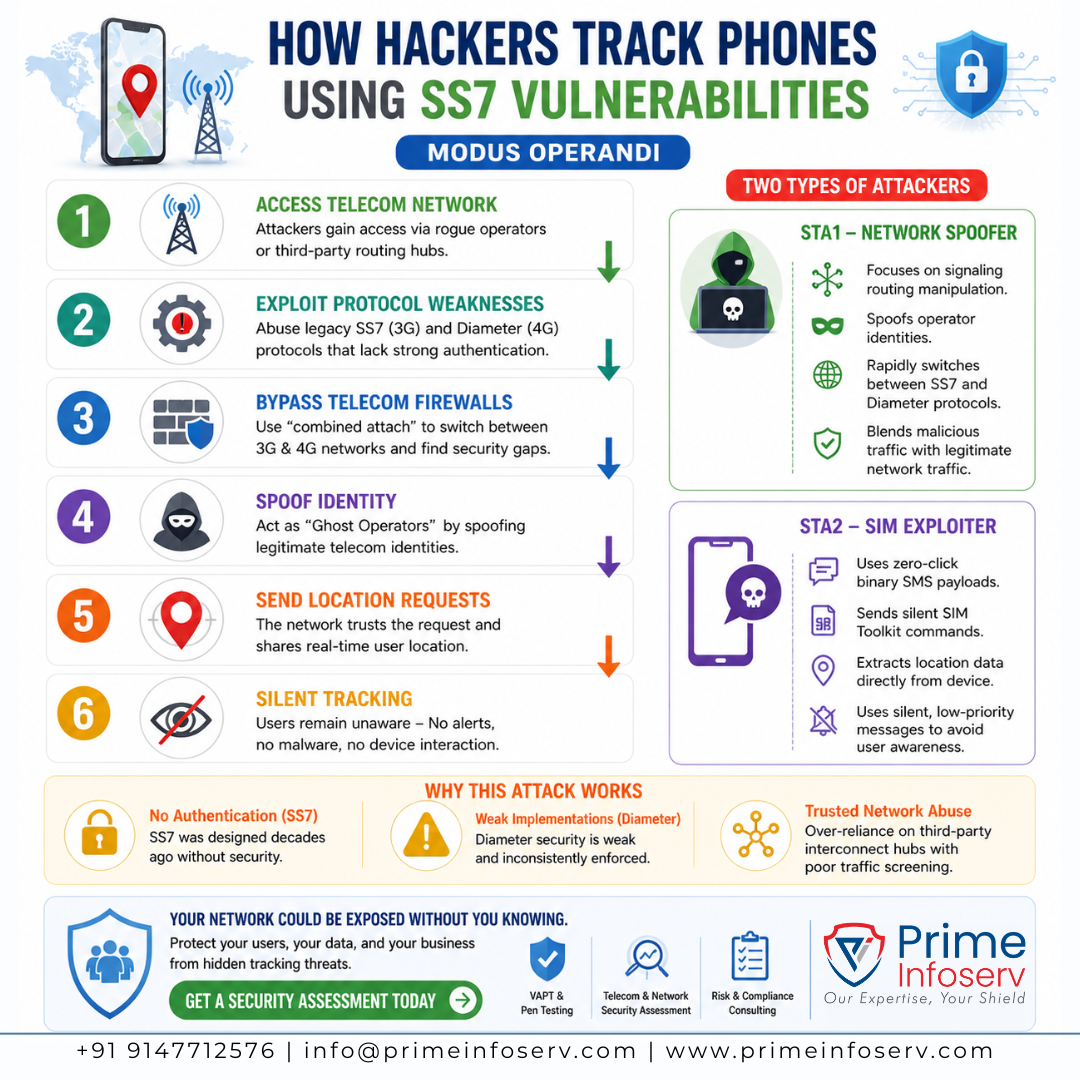
Step-by-Step Attack Flow
- Attackers abuse legacy 3G SS7 and 4G Diameter signaling protocols
- They bypass telecom firewalls by exploiting weak or missing authentication
- Using combined attach procedures, they force devices to connect to both 3G and 4G networks
- This allows seamless switching between SS7 and Diameter to find security gaps
- Attackers manipulate routing data to disguise themselves as legitimate telecom operators
- The network unknowingly shares real-time location data of users
These attackers act as “Ghost Operators”, masking their identity while tracking high-value targets globally.
Two Types of Threat Actors Identified
STA1 – Network Spoofer
- Focuses on signaling routing manipulation
- Spoofs legitimate telecom operator identities
- Rapidly switches between SS7 and Diameter protocols
- Blends malicious traffic with normal network activity to avoid detection
Result: Silent, large-scale location tracking without touching the device
⚠️ STA2 – SIM Exploiter
- Uses a more invasive hybrid approach
- Combines SS7 network probing with zero-click binary SMS attacks
- Sends silent SIM Toolkit commands to extract location data
- Uses low-priority messages that don’t trigger alerts on the phone
Result: Direct device-level data extraction without user awareness
Why These Attacks Are Possible
These global attacks exist due to structural flaws in telecom systems:
- SS7 Protocol: No authentication mechanism
- Diameter Protocol: Weak and inconsistent security implementation
- Heavy reliance on trusted interconnect networks
- Poor traffic filtering by third-party telecom routing hubs
In simple terms: telecom networks still operate on outdated trust models
How to Prevent or Reduce the Risk
While users cannot directly fix telecom protocols, you can still minimize exposure:
For Individuals
- Avoid publicly sharing your phone number
- Use encrypted communication apps wherever possible
- Keep your phone updated with latest security patches
- Disable unnecessary SIM toolkit or carrier-based services
- Be cautious of unusual network behavior (sudden signal drops, etc.)
For Organizations & Telecom Providers
- Implement advanced telecom firewall protection
- Monitor signaling traffic for anomalies
- Conduct regular VAPT and telecom security assessments
- Reduce dependency on untrusted interconnect hubs
- Enforce stronger authentication mechanisms
How Prime Infoserv Can Help
At Prime Infoserv, we help organizations uncover and mitigate hidden risks within their network and telecom infrastructure.
Our Key Services
- Vulnerability Assessment & Penetration Testing (VAPT)
- Telecom & Network Security Assessments
- Cybersecurity Maturity Assessments
- Compliance & Risk Consulting (ISO 27001, SOC 2, etc.)
What We Deliver
- Identification of risks like SS7 Network Vulnerabilities
- Proactive threat detection strategies
- Strengthened telecom and infrastructure security
- Compliance-ready security frameworks
Final Takeaway
The findings from Citizen Lab highlight a serious global issue—mobile users can be tracked without any direct interaction or warning. As long as telecom networks rely on outdated trust-based systems, these risks will persist.
Understanding these threats is the first step toward building a more secure digital environment. Call us for a free consultation : +91 9147712576 or mail: info@primeinfoserv.com