When businesses evaluate their cybersecurity needs, they often ask one question.
Specifically, how does Vulnerability Scanning vs Penetration Testing inform their choices?
“Do we need vulnerability scanning, penetration testing, or both?”
The confusion is understandable.
Vulnerability Scanning vs Penetration Testing identify weaknesses in IT environments and other digital assets.
However, they answer different security questions.
A vulnerability scan primarily helps you discover and prioritize potential weaknesses across your environment. Penetration testing goes further by using controlled, authorized attack techniques to validate whether weaknesses can actually be exploited and what an attacker might achieve. NIST includes both vulnerability scanning and penetration testing among the techniques organisations can use as part of a broader security testing and assessment program.
The important point is this:
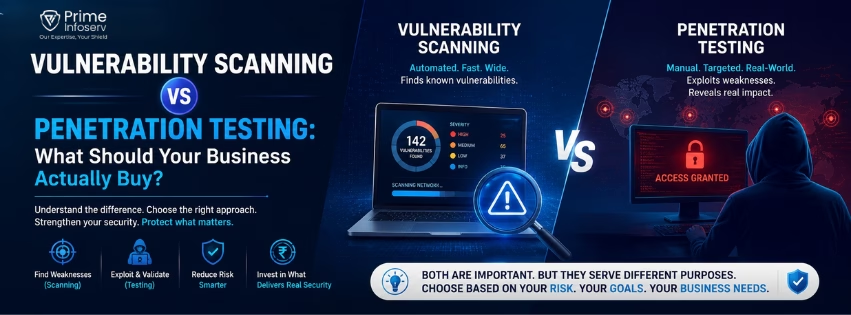
A vulnerability scan tells you where potential weaknesses exist. A penetration test helps determine what those weaknesses could actually allow an attacker to do.
So, which one should your business buy?
The answer depends on your objectives, environment, risk profile and security maturity.
What Is Vulnerability Scanning?
Vulnerability scanning is a systematic process used to identify known security weaknesses across systems, networks, applications and other assets.
Scanning tools examine assets for indicators such as:
- Missing security patches
- Outdated software
- Known vulnerabilities
- Insecure configurations
- Open ports and services
- Weak security settings
- Unsupported software
- Exposed systems
- Common configuration errors
Because scanning can be highly automated, organisations can perform it regularly across large environments.
For example, a company with hundreds of servers may use vulnerability scanning to identify which systems are running outdated software or contain known vulnerabilities.
The objective is not necessarily to compromise the system.
Instead, the objective is to build visibility into the organization’s vulnerability landscape and help security teams prioritize remediation.
CISA similarly describes vulnerability scanning as a way to identify vulnerabilities affecting internet-accessible assets and services.
What Is Penetration Testing?
Penetration testing is a controlled security exercise in which authorized security professionals attempt to exploit weaknesses using techniques that resemble those used by real-world attackers.
Rather than simply asking:
“Is there a vulnerability?”
a penetration test asks:
“Can this vulnerability actually be exploited, and what could an attacker accomplish if it were?”
Depending on the scope, testers may attempt to:
- Gain unauthorized access
- Exploit application vulnerabilities
- Bypass authentication controls
- Escalate privileges
- Access sensitive information
- Move between systems
- Exploit insecure configurations
- Chain multiple weaknesses together
- Demonstrate potential attack paths
Penetration testing therefore provides a deeper perspective on practical exploitability and business impact.
NIST describes penetration testing as one of the techniques used to validate vulnerabilities and assess security controls.
Vulnerability Scanning vs Penetration Testing: The Key Difference
The easiest way to understand the distinction is to think about breadth versus depth.
Vulnerability scanning = Broad visibility
A scan can examine a large number of systems and identify potential weaknesses quickly.
Penetration testing = Deeper validation
A penetration test focuses on a defined scope and attempts to demonstrate how weaknesses could be exploited.
| Area | Vulnerability Scanning | Penetration Testing |
|---|---|---|
| Primary purpose | Identify potential vulnerabilities | Validate exploitability and attack paths |
| Typical approach | Highly automated | Human-led with specialised tools |
| Coverage | Broad | Targeted and deeper |
| Exploitation | Generally not the objective | Controlled exploitation is part of the test |
| Frequency | Can be performed regularly | Usually scheduled periodically or around major changes |
| Output | Vulnerability findings and prioritisation | Validated vulnerabilities, attack paths and evidence |
| Best for | Continuous visibility | Deeper security validation |
| Resource requirement | Generally lower | Generally higher |
| Human expertise | Important for validation | Critical |
| Business impact | Helps prioritise remediation | Demonstrates potential real-world consequences |
The two approaches are complementary rather than competing alternatives. NIST specifically notes that no single testing technique provides a complete picture and recommends combining appropriate techniques for robust assessments.
Why a Vulnerability Scan Alone May Not Be Enough
Imagine your vulnerability scanner identifies a high-severity vulnerability on an internet-facing server.
That is valuable information.
But several questions may remain unanswered:
- Can an attacker actually exploit it?
- Is the vulnerable service reachable?
- Can the vulnerability be chained with another weakness?
- What privileges could an attacker obtain?
- Could the attacker access sensitive data?
- Could the attacker move further into the network?
- Are existing security controls capable of detecting or stopping the attack?
A vulnerability scan may identify the potential weakness.
A penetration test can investigate the practical attack scenario within the agreed rules of engagement.
This is why treating a vulnerability scan as a complete replacement for penetration testing can create a false sense of security.
Why Penetration Testing Doesn’t Replace Vulnerability Management
The opposite mistake is also common.
An organisation may conduct a penetration test once a year and assume that it has sufficient visibility into its vulnerabilities.
But technology environments change constantly.
New:
- Applications
- Servers
- APIs
- Cloud resources
- Software versions
- Network configurations
- User accounts
- Third-party integrations
can introduce new weaknesses.
A penetration test provides a point-in-time assessment of a defined scope.
Regular vulnerability management can provide broader and more continuous visibility.
Therefore, mature security programs generally don’t ask:
“Should we scan or penetration test?”
They ask:
“How should scanning, vulnerability management and penetration testing work together?”
When Should Your Business Consider Vulnerability Scanning?
Vulnerability scanning can be particularly useful when your organisation:
1. Has a large IT environment
If you manage many servers, endpoints, network devices or applications, automated scanning can help identify weaknesses across a broad asset base.
2. Frequently changes infrastructure
Cloud deployments, software updates and infrastructure changes can introduce new vulnerabilities.
Regular scanning helps maintain visibility.
3. Wants ongoing vulnerability visibility
Security teams can use recurring scans to identify newly discovered vulnerabilities and track remediation.
4. Is building a vulnerability management program
Scanning can form an important component of a structured vulnerability management lifecycle.
5. Needs to prioritize remediation
A large vulnerability list can become difficult to manage.
Scanning results can help teams identify which systems and vulnerabilities require attention first.
When Should Your Business Consider Penetration Testing?
Penetration testing becomes particularly valuable when you need deeper assurance.
Consider penetration testing when:
1. You are launching a critical application
A new internet-facing application can become a valuable target for attackers.
Testing before launch can help identify weaknesses before the application reaches customers.
2. You have a major infrastructure change
Significant changes to network architecture, cloud environments or security controls may justify deeper testing.
3. You handle sensitive information
Businesses processing financial, healthcare, personal or confidential information may have stronger reasons to validate security controls.
4. You need to test real-world attack scenarios
If leadership wants to understand how an attacker might move from an initial weakness to a meaningful compromise, penetration testing can provide that perspective.
5. You need independent security validation
An external assessment can provide an additional layer of assurance beyond internal testing.
6. You are preparing for specific customer or regulatory requirements
Some customers, contracts or compliance programs may require specific security testing. The exact requirement should always be checked against the applicable standard, contract or regulation.
What About Web Applications and APIs?
Modern businesses increasingly depend on web applications, APIs and digital platforms.
A traditional infrastructure vulnerability scan may not be sufficient to evaluate application-specific risks.
Web application penetration testing can examine areas such as:
- Authentication
- Authorization
- Session management
- Input validation
- Access control
- Business logic
- API security
- Data exposure
- Security configurations
For example, an application might have technically secure servers but still contain a business logic flaw that allows an authenticated user to access information belonging to another user.
That type of issue may require deeper application-focused testing rather than relying solely on infrastructure scanning.
Prime Infoserv’s VAPT offering includes security testing across infrastructure as well as web and mobile applications, with its service page highlighting both vulnerability assessment and penetration testing as distinct components.
The Role of Human Expertise
One of the biggest misconceptions about cybersecurity testing is that purchasing a scanning tool automatically means you have completed a security assessment.
Tools are extremely useful.
But tools don’t understand your business in the same way an experienced security professional can.
A security expert can interpret findings in context, investigate unusual behavior, validate vulnerabilities, understand attack paths and determine whether seemingly separate weaknesses can be combined.
For penetration testing in particular, human judgment is essential because attackers do not necessarily follow a predefined scanner workflow.
Prime Infoserv describes its VAPT approach as combining advanced tools with human intelligence and expert-led testing, with a focus on actionable remediation rather than simply producing a report.
A Simple Example
Consider an e-commerce company.
A vulnerability scan discovers:
Finding: An outdated software component is present on a public-facing server.
The security team now knows there is a potential weakness.
A penetration test may investigate whether the weakness can be exploited within the agreed scope and whether it provides a pathway to:
Internet → Application → Server → Privileged Access → Sensitive Data
The second scenario gives leadership a very different understanding of risk.
It transforms a technical finding into a potential business-impact discussion.
That is one of the major values of penetration testing.
So, What Should Your Business Actually Buy?
There isn’t a universal answer.
Your choice should be based on what question you need answered.
If your question is:
“What vulnerabilities exist across my environment?”
Start with vulnerability assessment/scanning.
If your question is:
“Can an attacker actually exploit these weaknesses?”
Consider penetration testing.
If your question is:
“How resilient is my environment against realistic attack paths?”
You may need a more comprehensive security assessment that combines multiple testing techniques.
If your question is:
“How do I continuously manage vulnerabilities and validate security?”
You should consider a broader program involving:
Asset visibility → Vulnerability scanning → Risk prioritization → Remediation → Validation → Penetration testing → Continuous monitoring
Why Businesses Shouldn’t Treat Security Testing as a One-Time Exercise
A security assessment is a snapshot.
Your environment isn’t.
New vulnerabilities are discovered. Software changes. Employees join and leave. Cloud infrastructure expands. Applications are updated. New integrations are introduced.
That means a system that was secure six months ago may have a completely different risk profile today.
A mature security strategy therefore treats testing as part of an ongoing security lifecycle rather than a once-a-year checkbox.
The Bottom Line
Vulnerability scanning and penetration testing serve different purposes.
Vulnerability scanning helps organisations achieve broad visibility and identify potential weaknesses.
Penetration testing provides deeper validation by investigating whether weaknesses can be exploited and what impact they may have.
For many organisations, the strongest approach isn’t choosing one over the other.
It’s using both strategically.
A vulnerability management program can provide ongoing visibility, while periodic penetration testing can provide deeper validation of critical systems, applications and attack paths.
The goal isn’t simply to collect a list of vulnerabilities.
The goal is to understand which weaknesses create meaningful business risk—and fix them before an attacker does.
How Prime Infoserv Can Help
Prime Infoserv provides Vulnerability Assessment & Penetration Testing (VAPT) services designed to help organisations identify security gaps, validate weaknesses and strengthen their overall security posture.
Its security testing capabilities include:
- Vulnerability Assessment
- Penetration Testing
- Web Application Security Testing
- Mobile Application Security Testing
- Network Security Assessment
- Cloud Security Assessment
- Security Audits
- Red Teaming
Prime Infoserv states that its approach combines advanced security tools with expert-led testing and focuses on actionable security improvements and remediation support.
If you’re unsure whether your organisation needs vulnerability scanning, penetration testing or a broader VAPT program, the right starting point is to assess your assets, business risk, technology environment and security objectives.
Don’t just ask whether your systems have vulnerabilities. Ask whether those vulnerabilities can become an attack path.
Ready to understand your actual security exposure? Talk to 9147712576 Prime Infoserv about a VAPT assessment.