
A recent report circulating widely this year has once again highlighted the growing cyber threats in India. Based on telemetry data from Kaspersky, cybersecurity researchers observed a massive number of online attacks targeting users across the country.
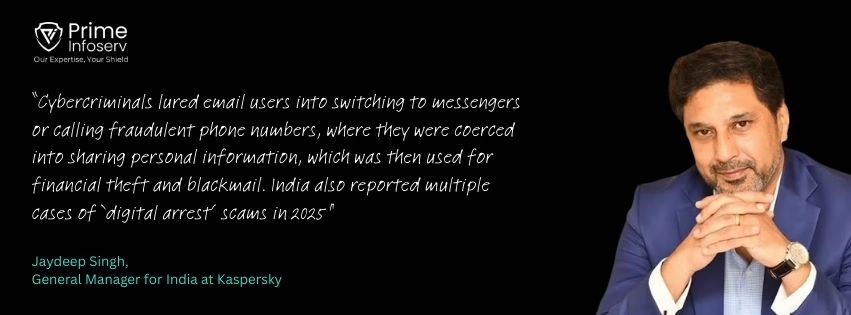
According to Jaydeep Singh, general manager for India at Kaspersky, the scale of threats detected in 2025 clearly shows how rapidly cybercrime is evolving. Kaspersky security systems reportedly detected and blocked millions of malicious attempts throughout the year.
With the rapid adoption of digital technologies and online services, individuals and businesses are increasingly relying on web-based platforms for banking, payments, communication, and daily operations. While this digital shift has made life more convenient, it has also made users easier targets for web-borne cyber threats.
As more services move online, cybercriminals are continuously refining their techniques. Let’s take a closer look at some of the major cybersecurity trends in 2025 that security researchers observed.
1. Digital Arrest Scams in India Are Increasing
One of the more alarming trends reported recently is the rise of digital arrest scams in India.
In these scams, attackers impersonate law-enforcement authorities and accuse victims of being involved in illegal activities. The victim is then pressured into staying on video calls or messaging platforms while the attackers claim they are under “virtual custody.”
The criminals use fear and psychological pressure to force victims into transferring money or sharing sensitive information. These digital arrest scams have become more sophisticated and are increasingly targeting professionals, executives, and even senior citizens.
2. Fileless Malware Attacks Are Becoming Harder to Detect
Another major threat highlighted in recent research is the growing use of fileless malware attacks.
Unlike traditional malware that installs files on a system, fileless malware operates directly in system memory. Because it leaves minimal traces on the hard drive, it is significantly harder for traditional antivirus solutions to detect.
These attacks often exploit browser vulnerabilities, legitimate system tools, or compromised credentials. As organizations rely more on cloud and web applications, fileless malware attacks are becoming a preferred technique for attackers attempting to remain undetected.
3. QR Code Phishing and Phishing Email Attacks
Phishing continues to remain one of the most common attack methods worldwide. However, attackers are now refining their techniques.
Security researchers are observing a rise in QR code phishing, where malicious links are hidden inside QR codes. When users scan the code on their mobile devices, they may unknowingly be redirected to fraudulent websites designed to steal login credentials or financial information.
At the same time, phishing email attacks are becoming more convincing. Attackers frequently disguise malicious links using link-shortening or protection services, making it harder for users to identify fake URLs.
These phishing campaigns often increase during large sales events, festive seasons, and promotional periods when users are more likely to click on offers and notifications.
4. Cyber Threats in India Statistics Observed by Kaspersky in 2025
Data obtained through the Kaspersky Security Network (KSN) highlights the massive scale of threats targeting users in India.
Some key India cyber threat statistics for 2025 include:
- 47 million cyber threats in India were detected and blocked during the year
- Users faced an average of 130000 web threats per day
- Nearly 24.7% of internet users faced cyber threats
- India ranked 62nd globally in terms of users affected by web-borne threats
These numbers clearly show that cyber threats are no longer isolated incidents. They are continuous and widespread.
Why Cybersecurity Awareness Is More Important Than Ever
The sole purpose of sharing these insights is simple, to make people aware that digital threats are not hypothetical risks. They can happen anytime !
Organizations today store valuable assets online , from financial data to intellectual property and customer information. Losing access to that data, or having it stolen, can have serious financial and reputational consequences.
Security teams also face another growing challenge known as alert fatigue. With thousands of alerts generated daily by security tools, teams can sometimes overlook genuine threats. Cybercriminals are increasingly exploiting this by launching alert storms, overwhelming security systems to hide real attacks within the noise.
Think of cybersecurity like the lock on your front door. You don’t install a lock because you expect someone to break in tomorrow. You install it because it is better to be prepared than to deal with the consequences later. The same principle applies to digital security.
Protecting Your Organization from Rising Cyber Threats
The growing scale of cyber threats in India makes it essential for organizations to take proactive security measures. This includes continuous monitoring, vulnerability testing, employee awareness training, and advanced threat detection technologies.
At Prime Infoserv, we help organizations stay ahead of evolving cyber threats through services such as:
- Vulnerability Assessment & Penetration Testing (VAPT)
- Web Application Penetration Testing (WAPT)
- SOC Monitoring with SIEM/SOAR
- EDR/XDR Threat Detection
- Attack Surface Management
- Phishing Simulations & Security Awareness Training
If your organization wants to understand how exposed it is to modern cyber threats like digital arrest scams, fileless malware attacks, QR code phishing, and phishing email attacks, our cybersecurity experts can help you assess and strengthen your defenses.
Get in touch with Prime Infoserv today for a cybersecurity consultation and ensure your organization stays protected in an increasingly hostile digital environment. Call:+91 9147712576 or mail: info@primeinfoserv.com