Introduction: Why 2025 Marks a Defining Moment for Cybersecurity
Cybersecurity in 2025 has crossed a critical threshold. It is no longer viewed as a technical safeguard operating quietly in the background—it has become a core determinant of business continuity, public trust, and national resilience.
From AI-powered phishing campaigns to ransomware disrupting essential services, cyber incidents today carry consequences that extend far beyond IT systems. They affect revenue, reputation, regulatory standing, and leadership accountability.
This blog presents a comprehensive, evidence-based view of Cybersecurity Threats Statistics 2025 and Government of India Initiatives, combining global trends, real-world breach examples, and emerging threat patterns with a focus on India. The objective is not alarmism, but clarity—helping leaders understand where cyber risk truly stands today.
Global Cybersecurity Threats Statistics and Facts 2025
The Economic Scale of Cybercrime
In 2025, global cybercrime is estimated to cost the world over USD 10.5 trillion annually, making it one of the largest economic threats of the digital age. These costs stem not only from direct financial theft but also from operational disruption, legal liabilities, regulatory penalties, and long-term reputational damage.
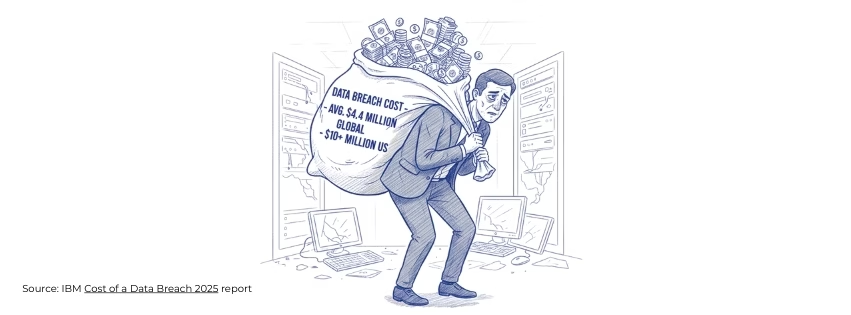
According to IBM’s Cost of a Data Breach 2025 report, the average global cost of a data breach in 2025 is approximately USD 4.4 million. In heavily regulated markets such as the United States, the figure exceeds USD 10 million per incident, reflecting higher legal exposure and compliance requirements.
Time to Detect and Contain Breaches
Despite advancements in detection technologies, the average time to identify and contain a breach remains close to 240 days. This prolonged dwell time allows attackers to:
- Escalate privileges
- Move laterally across systems
- Exfiltrate sensitive data
- Deploy ransomware at maximum impact points
Speed of response has improved marginally, but attackers continue to outpace defenders by exploiting complexity and human error.
Top Cyber Attack Patterns and Trends in 2025
1.Ransomware Remains the Primary Threat
Ransomware continues to dominate the threat landscape, featuring in over 40% of major cyber incidents globally. Modern ransomware operations are highly organized, offering “ransomware-as-a-service” models that lower entry barriers for criminals while increasing attack volume.
2. Credential Theft and Identity Compromise
Stolen credentials are now among the top initial access vectors, accounting for roughly one in five breaches. Weak passwords, lack of multi-factor authentication, and credential reuse remain persistent vulnerabilities.
3. The Human Factor
Approximately 60% of cybersecurity breaches in 2025 involve human factors, including phishing, social engineering, misconfigurations, and poor access controls. Technology may be advanced, but human behaviour continues to be the weakest link.
4. AI-Assisted Attacks
Artificial intelligence has reshaped cybercrime. In 2025, AI-enabled attacks including deepfake voice fraud, automated phishing, and adaptive malware are present in a growing share of incidents. These attacks are faster, more convincing, and harder to detect.

Major Global Cybersecurity Breaches of 2025
- Attacks on Critical Infrastructure
Public infrastructure has emerged as a high-value target. In multiple countries, ransomware attacks disrupted water utilities, municipal services, and transport systems, forcing authorities to shut down digital operations and revert to manual controls.
Such incidents underline the growing intersection between cybersecurity and public safety.
2. Aviation and Transportation Sector Breaches
The aviation industry witnessed significant breaches in 2025, with millions of customer records exposed. These incidents revealed persistent weaknesses in legacy systems and third-party integrations, highlighting the risks of complex digital ecosystems.
3. Education and Child Data Exposure
Educational institutions were heavily targeted due to limited security budgets and sensitive data holdings. In one widely reported case, ransomware attacks led to the exposure of student and staff data across multiple institutions, raising serious concerns around child data protection and regulatory oversight.
Top Cybersecurity Trends in 2025
1.Artificial Intelligence: Acceleration on Both Sides
AI has become a force multiplier. While attackers use it to automate reconnaissance and deception, defenders increasingly rely on AI for:
- Behavioral anomaly detection
- Threat correlation
- Automated incident response
Cybersecurity in 2025 is defined by an AI-driven arms race.
2.Supply Chain and Third-Party Risk
Nearly half of global organizations have experienced security incidents originating from vendors or software supply chains. Attackers increasingly compromise trusted partners rather than directly targeting well-defended enterprises.
3.Cloud and SaaS Misconfigurations
Rapid cloud adoption has led to widespread misconfigurations—publicly exposed storage, excessive privileges, and insecure APIs. These remain among the most common causes of data exposure in 2025.
4.Identity as the New Security Perimeter
With remote work and cloud services now standard, traditional network boundaries have dissolved. Identity and access management failures have become a leading cause of breaches, accelerating adoption of Zero Trust principles.
The Reality of Cybersecurity in India 2025
Scale of Cyber Threats in India
India has become one of the most targeted countries globally due to rapid digitization and massive user adoption. In 2025:
- Over 265 million cyberattack attempts were recorded
- Hundreds of millions of malware detections occurred across endpoints
- Estimated financial losses crossed ₹20,000 crore
The combination of scale, diversity, and uneven cyber maturity has significantly expanded India’s attack surface.
Major Cyber Threats Impacting India in 2025
1. Financial and UPI Fraud
Digital payment fraud dominates India’s cybercrime landscape. UPI scams, fake investment platforms, and loan app fraud collectively result in monthly losses running into thousands of crores.
2.Ransomware Attacks on Institutions
Ransomware attacks surged across Indian states in 2025, affecting hospitals, manufacturing units, educational institutions, and government offices. In some regions alone, tens of thousands of incidents were reported.
3.IoT and Surveillance System Exploitation
A notable 2025 incident exposed tens of thousands of compromised CCTV feeds from hospitals, schools, and businesses. Default credentials and unpatched devices remain widespread vulnerabilities.
4.Social Engineering and Digital Blackmail
Scams involving fake video calls, romance fraud, and deepfake extortion increased sharply. These attacks exploit psychological manipulation rather than technical weaknesses, making detection and prevention more complex.
Cyber Security Initiatives by the Government of India & Regulatory Measures
1.Strengthening Cybercrime Coordination
The Indian Cyber Crime Coordination Centre (I4C) continues to play a central role in national cybercrime reporting, investigation support, and training. Daily cybercrime reporting reflects the persistent scale of threats.
2.Capacity Building and Awareness
State governments have expanded cybercrime training for law enforcement personnel, recognizing that effective response requires skilled investigators alongside technology.
3.Data Protection and Governance
The Digital Personal Data Protection (DPDP) Act has elevated accountability for data handling, breach notification, and governance, bringing India closer to global privacy and security norms.
Why Cybersecurity Is a Boardroom Issue in 2025
Cyber incidents today directly affect:
- Business continuity
- Regulatory compliance
- Brand trust
- Leadership accountability
Cybersecurity has become inseparable from enterprise risk management and corporate governance. Boards and CXOs are increasingly expected to understand cyber risk, not just delegate it.
Strategic Lessons from Cyber Incidents in 2025: Global and India
- Prevention alone is insufficient—detection and response maturity are critical
- Human risk management must complement technical controls
- Third-party risk requires continuous oversight
- Identity security is foundational to modern defense
- Resilience, not absolute security, is the realistic objective
Conclusion: The Key Question Leaders Must Ask About Cybersecurity in 2025
Cybersecurity in 2025 reflects a simple but uncomfortable truth: Attacks are inevitable. Catastrophic impact is not—if preparedness exists.
For India and the world, cybersecurity is no longer about defending systems alone. It is about protecting trust, continuity, and confidence in the digital economy.
The defining question for organizations is no longer “Will we be attacked?”
It is “How prepared are we when it happens?”